
From genomes to clinical samples: direct qPCR detects drug-resistance biomarkers in dogs with leishmaniosis
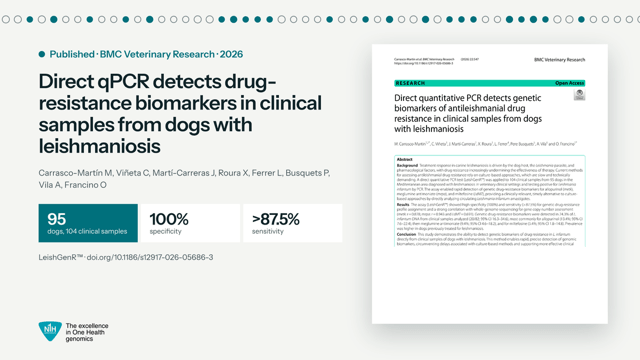
First came the identification of genetic biomarkers of resistance to allopurinol, meglumine antimoniate and miltefosine. Then came their detection by whole-genome sequencing in cultured Leishmania infantum isolates. Now our study in BMC Veterinary Research shows they can be detected by quantitative PCR directly in clinical samples from dogs.
Working on the clinical sample removes the need to culture the parasite, which takes weeks and often fails. Results arrive in time to guide the choice of treatment.
We analysed 104 clinical samples from 95 dogs with leishmaniosis in the Mediterranean area. The assays detected the resistance biomarkers with 100% specificity and over 87.5% sensitivity. Drug-resistance biomarkers were found in 24.3% of the samples analysed, about one in four, most often for allopurinol, then meglumine antimoniate and miltefosine. They were more frequent in dogs that had already been treated for leishmaniosis.
The study validates the approach behind LeishGenR™, now available to veterinarians through UranoVet in Spain and Portugal and MyLav in Italy and the rest of Europe. It was led by Marina Carrasco-Martín within her Industrial Doctorate at Nano1Health. And the next step is coming soon.
Reference: Carrasco-Martín M, Viñeta C, Martí-Carreras J, Roura X, Ferrer L, Busquets P, Vila A, Francino O. Direct quantitative PCR detects genetic biomarkers of antileishmanial drug resistance in clinical samples from dogs with leishmaniosis. BMC Veterinary Research 22: 547 (2026). https://doi.org/10.1186/s12917-026-05686-3
Questions about this news? Write to info@nano1health.com.