
From qPCR to digital PCR: detecting drug-resistance biomarkers in dogs with low parasite loads
In July we showed in BMC Veterinary Research that LeishGenR™ detects drug-resistance biomarkers by qPCR directly in clinical samples from dogs. That works well when the parasite load is high, as in bone marrow or lymph node. But many of the samples vets send for follow-up are blood or skin, where parasites are scarce and qPCR becomes less reliable.
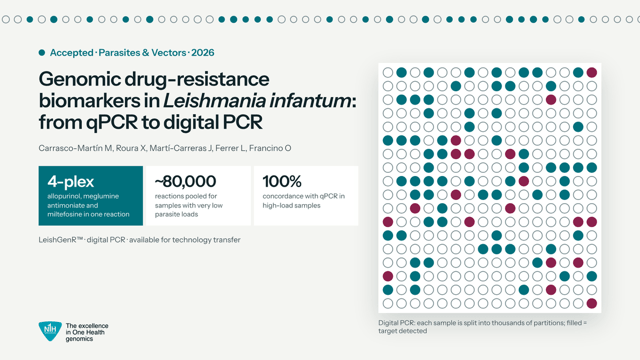
Our new study, accepted in Parasites & Vectors, takes the next step: digital PCR. The test splits each sample into thousands of tiny separate reactions and counts the target DNA molecules one by one. This gives absolute quantification, with no standard curves. A single 4-plex reaction reads the biomarkers for allopurinol, meglumine antimoniate and miltefosine at the same time.
We validated the assay on Leishmania infantum isolates already characterised by whole-genome sequencing and qPCR. Resistance profiles were fully concordant for allopurinol and miltefosine and nearly so for meglumine antimoniate, with high repeatability between runs. In clinical samples from dogs in Spain and Greece, the profiles matched qPCR in every sample with a high parasite load. In samples with a very low parasite load, combining around 80,000 reactions gave a reliable resistance profile where qPCR could not.
Digital PCR extends drug-resistance testing to the samples where it was hardest, and helps vets tell whether a relapse is due to resistance. The assay is now available for technology transfer to reference laboratories.
Reference: Carrasco-Martín M, Roura X, Martí-Carreras J, Ferrer L, Francino O. Genomic drug resistance biomarkers in Leishmania infantum: from quantitative real-time PCR to digital PCR. Parasites & Vectors (2026, accepted).
Questions about this news? Write to info@nano1health.com.